
John Bellocchio
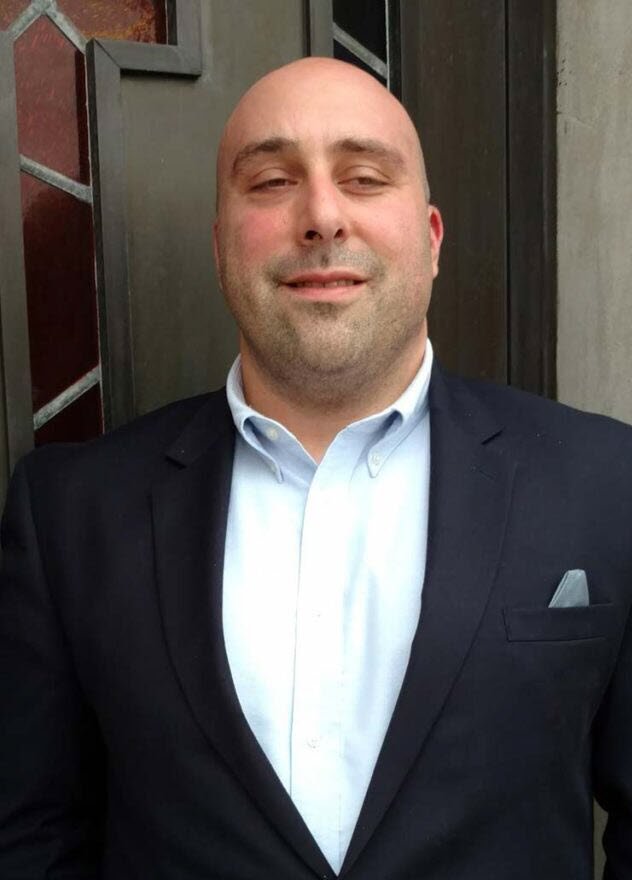
“I have found that healing grows when the Church sees survivors not as threats to its reputation, but as prophets for its renewal. Bishops who cannot or do not engage with this reality have chosen the wrong side of history.”
Awake: John, thank you for sharing your story with the Awake community. Would you tell us a bit about yourself and your life?
John Bellocchio: I’m a New Jerseyan in my forties, trained in education, psychology, and animal behavior. After 20 years in education, my work now centers on Fetch and More, the dog-training and service-dog consultancy I founded. My Labrador, Seamus, is both my constant companion and a reminder that love, patience, and humor can redeem even the most difficult days.
I have also dedicated myself to the St. Dymphna / Our Lady of Hope Society, a lay Catholic apostolate devoted to mental health ministry within the Diocese of Paterson, which has been a seminal partner in addressing a lot of the local issues victim-survivors face from the Church in New Jersey. My life today is quieter and more focused—structured around helping others heal, advocating for reform, and living out the Gospel through practical service.
Q: Your devotion to service and advocacy is truly inspiring. What would you feel comfortable sharing about your abuse?
A: I’ve been criticized over the years for not talking publicly about the blow-by-blow details of my own abuse, and I understand why people wonder about it. But the truth is simple: I’m a very private person, and I’ve never believed that my personal story needs to be on display in order for the work to matter. We may have all gotten to this point in different ships, but we’re in the same boat now. We should collectively focus on the future to prevent other children from ever being in the same boat. We must never let the opportunity for alliances, whether among victim-survivors or between victim-survivors and the Church, pass us by.
What happened to me is the reason I fight, but it is not the content of the fight. I focus on advocacy because I refuse to let my life be reduced to someone else’s crime. My energy goes into exposing systems, pushing for accountability, and making sure the next kid doesn’t get crushed the way I did — not into retelling my trauma for public consumption. Survivors don’t owe the world their pain in graphic detail to be credible. What we owe each other is action, honesty, and a relentless commitment to making things safer than they were for us.
Q: Thank you for sharing this, John. We certainly honor your choice to keep these details private. You mentioned earlier your service to the St. Dymphna / Our Lady of Hope Society. What else would you like to say about your faith in God and your spirituality?
A: Faith, for me, has always been an active verb — something lived, wrestled with, sometimes wept over, and always returned to. I had a teacher a long time ago who used to interrupt presentations that went too long by saying, “Time to stop the talk and start the do!” I have always applied that same principle to the Gospel; it’s a mechanism of action. My journey as a survivor and advocate has been about what it means to live as a Catholic who refuses to surrender hope while still demanding justice.
I try to begin each morning by asking how I can serve the Gospel today with my actions. Sometimes that means writing to a bishop; other times, it means sitting quietly with someone who has lost their faith and simply listening. Healing, like faith, is incarnational. It requires showing up.
Q: Is there someone who has been particularly helpful in your healing and recovery?
A: Several people have played key roles in my healing. Two bishops have played a significant role. One, Bishop Kevin Sweeney of Paterson, provided a light in my recovery; through the dialogue he willingly entered, he showed that men of goodwill can emerge from the darkest times and places. The other, Bishop Joseph Williams of Camden, has been a model of what courageous leadership looks like in this moment. He listens to understand. When I reached out to him about the painful culture that has too often silenced victim-survivors, he responded with presence. He reminded me that the Church is still capable of pastoral care that is real, visible, and grounded in the Gospel. His quiet persistence in walking alongside survivors and his willingness to face institutional sin with humility are characteristics I wish more bishops would emulate. It is also incredibly important to acknowledge the value of good counsel. An attorney should not only represent you, but truly serve as your guide and advocate. In Adam Green, I am fortunate to have that.
Q: I’m glad you have found helpful companions to walk with you on your journey, John. What have you learned along the way about healing?
A: The longer I walk this path, the more I realize that healing is a practice. Some days it looks like prayer; other days it looks like paperwork, letters, meetings, and long conversations that stretch into the night. It looks like Seamus resting at my feet as I type, a reminder that life, even in its woundedness, is still good. Similarly, reconciliation is a daily discipline — a decision to live free of hatred. To forgive does not mean to excuse or erase. It means to release the hold that bitterness can have on one’s soul. It means to reclaim one’s dignity from those who tried to diminish it.
Pope Francis has often spoken of the Church as a field hospital after battle — a place where the wounded can find care before condemnation. That image resonates deeply with me. Survivors should not have to prove their worthiness to be believed; they are already beloved by God. The field hospital is the parish that welcomes, the bishop who listens, the lay community that refuses to turn away. I have found that healing grows when the Church sees survivors not as threats to its reputation, but as prophets for its renewal. Bishops who cannot or do not engage with this reality have chosen the wrong side of history.
Q: You mentioned Pope Francis’s image of the Church as a field hospital, a site of care for the wounded. How do you see your relationship to the Catholic Church today?
A: When I began writing to Church leaders years ago, it wasn’t because I wanted confrontation. It was because I wanted conversation. Silence has always been the Church’s most dangerous habit. So I began to speak — not out of anger, but out of fidelity. The Church cannot be holy while hiding; it cannot preach reconciliation without first telling the truth.
The work I do today — advocating for survivors, writing letters to bishops and oversight bodies, and helping others reclaim their voices — comes from a conviction that justice is an act of faith. To seek justice is to participate in the kingdom; it is to believe that truth has the power to heal the body of Christ.
In recent years, I have poured much of my energy into the St. Dymphna / Our Lady of Hope Society. When I first shared the idea for this ministry with Bishop Sweeney, his response was immediate and pastoral. He helped guide it toward structure, accountability, and ecclesial partnership. Bishop Sweeney understood that St. Dymphna’s charism — healing through empathy and presence — was central to the Church’s mission. Together, we have worked to develop a framework where clergy and laity can walk together, acknowledging that mental and spiritual healing are inseparable. We are building something that transcends personal stories and becomes a communal witness. It is an act of reparation and reform that speaks louder than any press release ever could.
Q: Is there any wisdom from you have gleaned from experience that other survivors might benefit from hearing?
A: When I speak with other survivors, I often say that healing begins not in the courtroom but in the human heart. The law can provide justice, but only grace can restore the soul. That is not to diminish the importance of accountability — far from it. But it is to acknowledge that transformation requires encounter.
In the same way, I believe that reform in the Church will come from renewed encounter. As unpopular as this may be, I believe the victim-survivor community and support groups also need reform. I have sat across from bishops, priests, and lay leaders who were visibly shaken by the stories they heard. Some had never before looked into the eyes of someone who had survived what they had only read about in reports. It changes a person. It changes the Church. I have seen tears in rooms that were once silent. I have seen policies begin to move because hearts were moved first.
Freedom begins with truth. Truth begins with listening.
Q: Thank you for sharing your hard-won wisdom, John. What would you say has challenged you most on your journey, and how have you answered that?
A: There are days when I wonder why I stay. It would be easier, perhaps, to leave — to start fresh, to find peace elsewhere. However, the Church is not merely an institution; it is the Body of Christ, wounded but still holy, broken yet still beloved. To abandon it entirely would feel like abandoning the hope that it can be healed, as well as letting the forces of evil win.
I stay because I believe that reform is possible. I have seen glimpses of it — in Bishop Williams’ humility, in Bishop Sweeney’s partnership, in survivors who have found their voices and are now ministering to others. I stay because I believe that Christ is not finished with his Church. The same Spirit that descended at Pentecost still stirs hearts today. The same grace that turned Peter’s denial into discipleship can turn institutional sin into renewal.
Q: Since you are engaged in advocacy and reform, I wonder what would you like Catholics to understand about sexual abuse in the Catholic Church?
A. If there is one thing I want readers to take from my story, it is this: healing is a collective act. None of us can do it alone. The Church’s renewal depends on survivors, clergy, and laity walking together — each bringing their own gifts, wounds, and wisdom. True reform is about conversion. It is about restoring right relationships within the Body of Christ.
The St. Dymphna Society is one model of that collaborative reform. So is every diocese that opens its doors to independent audits, every parish that creates safe spaces for conversation, every bishop who invites survivors to the table as partners. Reform is about truth. It’s about the Church remembering who she is — the Bride of Christ, called to holiness through humility.
Q: As we wrap up our conversation, can you say a few words about what gives you hope as a survivor?
A. Hope, I have learned, is defiance. It is looking at brokenness and believing that love will have the last word. It is trusting that the God who raised Lazarus still calls us out of our tombs — not just as individuals, but as a Church.
When I look at the faces of other survivors — when I see courage where the world expected silence — I see the living image of the risen Christ. We are not relics of tragedy; we are witnesses to resurrection. The cross, after all, was a symbol of violence until love transformed it into victory.
That transformation is what I seek, not only in my own life but in the Church I still love. And it begins, always, with truth. For “the truth will set you free” (John 8:32).
I believe that freedom is coming — slowly, imperfectly, but surely. I believe that as long as there are people willing to speak, to listen, to forgive, and to act, the Church can still become what it was always meant to be: a refuge for the broken, a teacher of mercy, a servant of truth.
That is the faith I live. That is the Church I fight for. And that, I believe, is the Gospel — alive, incarnate, still unfolding.
—Interview by Katie Burke-Redys
Note from Awake: We extend heartfelt thanks to John Bellocchio for sharing his story. We also want to acknowledge that every survivor’s path is different. We honor the journeys of all who have experienced sexual abuse by Catholic leaders and are committed to bringing you their stories. In addition to John’s story, we encourage you to read our previous Survivor Stories here.
If you have experienced sexual abuse, you can receive support through the National Sexual Abuse Hotline, 800-656-4673, which operates 24 hours a day. If you seek support from the Catholic Church, you can find the contact information for your diocesan victim assistance coordinator here. Also, Awake is always open to listening to and learning from survivors. If you would like to connect with us, we invite you to email Executive Director Sara Larson at saralarson@awakecommunity.org.