
Vatican Reporter Wrestles With Faith, Finds Hope
The summer of 2018, often called the “summer of shame” by Catholics, was characterized by the Pennsylvania Grand Jury Report and the abuse revelations about then-cardinal Theodore McCarrick.
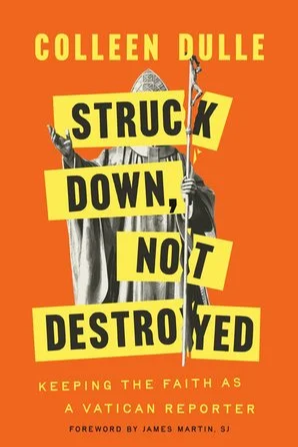
In her book Struck Down, Not Destroyed, Vatican reporter for America magazine Colleen Dulle reflects on her time covering these scandals and other current events in the Catholic Church, and the ways this has led her to wrestle with her faith and find hope. I was grateful for the opportunity to speak with her and reflect on some of the ideas and questions she delves into with her book.
“I've learned that the community of Catholics who share their pain and grief over the church's scandals often need to be reminded that they are just as much the church, and just as Catholic, as the people who govern the institution. And that feeling conflicted about your religious identity after a scandal is not a sin; it's normal.”
—Introduction
In the summer of 2018, Dulle, along with some of her fellow young colleagues at America, was reckoning with the sexual abuse crisis in the Catholic Church for the first time.
“We had been little kids when 2002 happened. We had been largely shielded from the last wave of the abuse scandal,” she said. “We were having to grapple with the reality as adults for the first time, whereas maybe we could have ignored it in the past, or it wasn't front and center for us all the time.”
While covering the scandals and connecting with abuse survivors was an intense experience, Dulle says she and her colleagues were motivated by the ways they could contribute to healing in the Church through their reporting.
“If the Catholic Church is ever going to heal and move forward and make amends to whatever extent that's possible, and also reform to ensure that it doesn't happen again, the first step to any of those processes has to be accepting the truth,” she said. “We saw it as our job, our vocation even, to help reveal that truth, whatever ways that we could.”
“I wrote [Jean] Vanier's obituary for America and did an interview about his death with Tina Bovermann, a spokeswoman for L'Arche USA, the last two of several articles and videos I'd done extolling Vanier's virtues, trying to spread his message that had changed my life . . . Less than a year later, I'd view it all with disdain.”
—Chapter 3: When Heroes Fall
Struck Down, Not Destroyed also includes Dulle’s reckoning with the influence of L’Arche founder Jean Vanier on her spiritual life when news about his spiritual and sexual abuse broke in February 2020, after his death.
“What do I do with his influence on me? Do I have to weed it all out of my head? Do I have to pull it out of my heart? And that wasn't going to be possible, and so suddenly I had to start thinking, ‘Okay, I was wrong to put him up on a pedestal. I was wrong even in my coverage of him, not to examine him more critically,’” she said. “In retrospect, I could see areas where I had overlooked things that I should have pushed on, like his association with Thomas Philippe.”
Thomas Philippe, a Dominican priest whom Vanier identified as a mentor and “spiritual father,” was found guilty of sexual abuse of adult women and prohibited from ministry in 1956.
Dulle shared that she started thinking with more nuance about sainthood, the difference between holiness and perfection, as well as the role of sin.
“The effect that all this had on my reporting was that while it got me thinking more complexly about holiness, it also got me thinking more complexly about the people I admired,” she said. “People who were still alive, it made me a little more skeptical, a little bit more hesitant. I certainly will probably not call anyone a living saint for the rest of my life, right? Because we just don't know.”
Dulle reflected on a conversation she had with Paul Fahey, where he shared that holding seemingly conflicting truths simultaneously is an important part of psychological maturity.
“That's something that's become really important to me over those years, as I was covering and dealing with all these various scandals in a really head-on way,” she said. “It was a hard realization, but holding things in tension is super, super important, and I think it's also just part of the Catholic faith, too.”
“I think part of why the synod gives me so much hope is that it was an experience of strugglers coming together, seeing one another's difficulties with the church, voicing the difficulties that had surfaced in similar conversations in their home contexts, and not dismissing them but taking them seriously. Saying, ‘I recognize your struggle. I know it, too, in my own way.’ Bishops saying it to laypeople. Laypeople saying it back to bishops.”
—Chapter 6: Moving From “I” to “We”
At the end of our conversation, Dulle shared that she has found great hope in the pontificate of Pope Leo XIV.
“Leo has this ability to get people on board and bring them together without shying away from difficult truths, and so I do have hope that he can help the U.S. Church overcome some of its divisions,” she said.
Finally, she shared that the synodal process and movement to make the Catholic Church less hierarchical and “more one where we all, as the people of God, see ourselves as responsible for the church, responsible for its mission,” to be another area where she finds hope.
“After the massive loss of credibility caused by the abuse crisis, one of the ways that you can rebuild credibility is by letting people feel like they have some responsibility and a voice in how this institution is run. And so, the synodal process feels like the first steps towards that,” she said. “I'm excited to see how that continues to play out over the course of my life, too.”
—Catherine Owers, Communications and Events Specialist
The Awake Blog will be taking a summer pause in the month of July. We’ll return in August with more great posts, including a recap of our two survivor retreats.
Click here to receive an email when new posts are published.